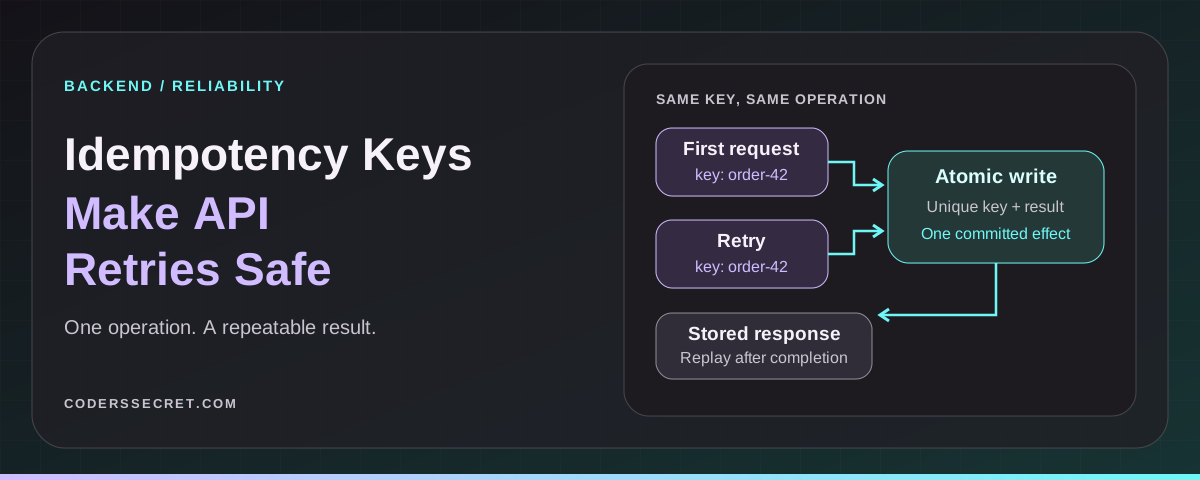
A client sends an order request, waits, and times out. Did the server reject it, or did it create the order just before the connection broke? A timeout cannot answer that question. Retrying an ordinary create operation can produce a second order.
An idempotency key identifies one intended operation across multiple delivery attempts. The server stores enough information to recognize a retry and return the original result. This guide builds a small executable example, then explains the concurrency, retention, and external-service boundaries that determine whether the design is safe.
Define the contract before writing the handler
The client creates a random key when the user starts an operation, persists it with that operation, and reuses it after network failures. A new purchase gets a new key, even if the basket is identical. Generating a fresh key inside every retry defeats deduplication.
POST /orders
Idempotency-Key: 02da4f91-5797-46bc-9be5-998a3a648b90
Content-Type: application/json

{"sku":"book-42","quantity":2}
Define the server-side scope as an authenticated principal or tenant, an operation name, and the key. Obtain identity from verified authentication, never from a tenant field supplied in the request body. Authentication and authorization must run again before replaying a stored response. A key is a correlation identifier, not a credential.
| Request | Contract for this example |
|---|---|
| New scope and key | Create one order and save the result atomically. |
| Same key and same validated input | Replay the stored status and response body. |
| Same key with different input | Reject the conflict without performing more work. |
| Concurrent attempts with the same key | Serialize ownership; the later attempt reads the committed result. |
| Key no longer retained | Treat as a new operation only under the documented retention contract. |
Response details are a product decision. For example, Stripe documents replaying the original status and body, including server errors, and checking that reused keys have matching parameters. Do not assume every API caches failures or retains keys for the same period. Document your own behavior alongside the rest of your API design contract.
Keep the result and the write in one transaction
A tempting implementation checks a cache, creates an order, and then saves the response. Two workers can both see a cache miss. A crash after creating the order but before saving the response also leaves the next worker unable to recognize the completed request.
For work confined to one database, put the business write and the idempotency record in the same transaction. Either both commit or neither commits. Return success only after commit. A unique constraint on the key scope protects the storage invariant; the handler must also coordinate concurrent ownership.
Run a local concurrency example
Save this as idempotency_demo.py and run python idempotency_demo.py with Python 3.12 or later and its SQLite module. It creates a disposable database in a temporary directory and runs eight attempts through separate connections. No API keys, packages, or server are needed.
This is the persistence core, not an HTTP server. The caller supplies an already authenticated tenant. Validation admits only a simple SKU and positive integer quantity, then fingerprints that normalized object. More complex APIs must define how defaults, decimals, omitted fields, and API versions affect request identity.
import hashlib
import json
import sqlite3
import tempfile
import uuid
from concurrent.futures import ThreadPoolExecutor
from pathlib import Path


def connect(path):
    # Explicit SQL controls the transaction lifecycle.
    return sqlite3.connect(path, timeout=10, autocommit=True)


def create_order(path, tenant, key, payload):
    if not tenant or not isinstance(key, str) or not 1 <= len(key) <= 128:
        raise ValueError("Invalid tenant or key")
    if not isinstance(payload, dict) or set(payload) != {"sku", "quantity"}:
        raise ValueError("Expected sku and quantity")
    sku, quantity = payload["sku"], payload["quantity"]
    if not isinstance(sku, str) or not 1 <= len(sku) <= 80:
        raise ValueError("Invalid SKU")
    if type(quantity) is not int or not 1 <= quantity <= 100:
        raise ValueError("Invalid quantity")

    normalized = json.dumps(
        {"sku": sku, "quantity": quantity}, sort_keys=True, separators=(",", ":")
    )
    fingerprint = hashlib.sha256(normalized.encode("utf-8")).hexdigest()
    scope = (tenant, "create-order:v1", key)
    db = connect(path)
    try:
        # SQLite serializes writers before the lookup.
        db.execute("BEGIN IMMEDIATE")
        previous = db.execute(
            "SELECT fingerprint, status, body FROM requests "
            "WHERE tenant = ? AND operation = ? AND request_key = ?", scope
        ).fetchone()
        if previous:
            if previous[0] != fingerprint:
                raise ValueError("Key reused with different input")
            result = (previous[1], json.loads(previous[2]))
        else:
            order_id = str(uuid.uuid4())
            db.execute(
                "INSERT INTO orders VALUES (?, ?, ?, ?)",
                (order_id, tenant, sku, quantity),
            )
            body = json.dumps({"order_id": order_id, "quantity": quantity})
            db.execute(
                "INSERT INTO requests VALUES (?, ?, ?, ?, ?, ?)",
                (*scope, fingerprint, 201, body),
            )
            result = (201, json.loads(body))
        db.execute("COMMIT")
        return result
    except BaseException:
        if db.in_transaction:
            db.execute("ROLLBACK")
        raise
    finally:
        db.close()


if __name__ == "__main__":
    with tempfile.TemporaryDirectory() as directory:
        path = Path(directory) / "orders.sqlite"
        db = connect(path)
        try:
            db.executescript("""
                CREATE TABLE orders (
                    id TEXT PRIMARY KEY, tenant TEXT NOT NULL,
                    sku TEXT NOT NULL, quantity INTEGER NOT NULL
                );
                CREATE TABLE requests (
                    tenant TEXT NOT NULL, operation TEXT NOT NULL,
                    request_key TEXT NOT NULL, fingerprint TEXT NOT NULL,
                    status INTEGER NOT NULL, body TEXT NOT NULL,
                    PRIMARY KEY (tenant, operation, request_key)
                );
            """)
        finally:
            db.close()

        payload = {"sku": "book-42", "quantity": 2}
        with ThreadPoolExecutor(max_workers=8) as workers:
            results = list(workers.map(
                lambda _: create_order(path, "tenant-a", "demo-key", payload),
                range(8),
            ))
        assert all(result == results[0] for result in results)
        try:
            create_order(path, "tenant-a", "demo-key", {**payload, "quantity": 3})
        except ValueError as error:
            assert str(error) == "Key reused with different input"
        else:
            raise AssertionError("Expected a conflicting-input rejection")

        db = connect(path)
        try:
            count = db.execute("SELECT COUNT(*) FROM orders").fetchone()[0]
        finally:
            db.close()
        assert count == 1
        print("8 attempts, 1 order, identical responses, conflicting input rejected")
The expected output is 8 attempts, 1 order, identical responses, conflicting input rejected. The assertions verify response equality and the business-row count, not just that a key was cached. The example stores successful results only. Validation failures happen before the transaction, and transactional failures roll back so a later attempt can try again.
SQLite permits one writer at a time, and BEGIN IMMEDIATE starts a write transaction immediately. This makes the lookup and insertion safe in this local example, but serializes unrelated writes too. A busy timeout can still expire; return a retryable failure rather than treating a lock error as permission to bypass deduplication. This is not a performance model for a high-throughput service.
Port the invariant, not the locking shortcut
In PostgreSQL, a plain SELECT followed by INSERT is not enough to claim a missing key. Use a unique key scope and an atomic insertion to claim it inside the transaction, then write the order and stored result before committing. A conflicting attempt waits or receives a bounded retryable outcome according to your timeout policy.
There is a subtle Read Committed case: INSERT ... ON CONFLICT DO NOTHING can decline an insert because of another transaction even when that row was not visible to the insertion's snapshot. Read the committed result in a subsequent statement, and handle a missing row or transaction retry explicitly. Do not assume a same-statement fallback SELECT always finds the winner. PostgreSQL documents this snapshot behavior.
Keep transactions short and enforce lock and statement timeouts. For long-running jobs, a durable operation resource with pending, succeeded, and failed states is often clearer. Concurrent clients can receive an operation URL instead of waiting for the entire job. Worker leases need ownership checks or fencing so an expired worker cannot overwrite a newer result.
A database transaction cannot undo an external payment
Suppose the handler commits an order and calls a payment provider. A process crash between those steps can leave either an unpaid order or an uncertain payment outcome. Putting the network call inside a local database transaction does not make the remote effect transactional.
One option is to write an outbox event with the order and idempotency result in the same transaction. A worker delivers the event later. That delivery can repeat, so derive a stable downstream idempotency key from the operation and use the provider's documented contract. Reconcile uncertain outcomes using the provider's operation identifier or lookup API. If the provider offers neither deduplication nor reconciliation, automated retries cannot promise a single effect.
The event-driven architecture guide explains related consumer and event-flow patterns. The outbox prevents losing the intent to send; it does not by itself prevent duplicate delivery. Avoid advertising an unrestricted exactly-once guarantee across independent systems.
Retention and replay are part of correctness
Choose a retention period that covers your supported retry and redelivery window, including offline clients and delayed workers. After a record is deleted, the same key can create another order. For business operations that must remain unique longer, also enforce a permanent business identifier, such as a merchant order reference.
The demo deliberately has no cleanup job. A production implementation needs expiry metadata, a bounded cleanup policy, and tests for late requests racing with cleanup. Protect stored responses like other tenant data. Cache only fields needed for replay, avoid secrets in keys or logs, and recheck access before returning an old result. If replay includes headers such as Location, persist or reconstruct them consistently too.
Retry with a deadline, bounded attempts, exponential backoff, and jitter. Deduplication limits business effects; it does not make unlimited retries cheap. Track replay rate, payload conflicts, lock wait time, transaction failures, and oldest pending operation. See the observability guide for connecting these signals to request traces.
Test the failure boundaries
- Send the same key concurrently and verify one business write and identical stored results.
- Change the payload while keeping the key and verify a conflict with no new write.
- Use the same key under a different tenant and verify independent operations and no response leakage.
- Fail after the business INSERT but before COMMIT, then retry and verify the incomplete transaction left no order.
- Drop the response after COMMIT, then retry and verify the original operation identifier is returned.
- Test expired keys, lock timeouts, and worker redelivery against the behavior promised to clients.
Start with one endpoint whose database effects can share a transaction. Write its retry contract, run the concurrency example, and add failure injection around commit. Expand to asynchronous or external work only after you can identify which system owns each effect and how an uncertain outcome will be recovered.